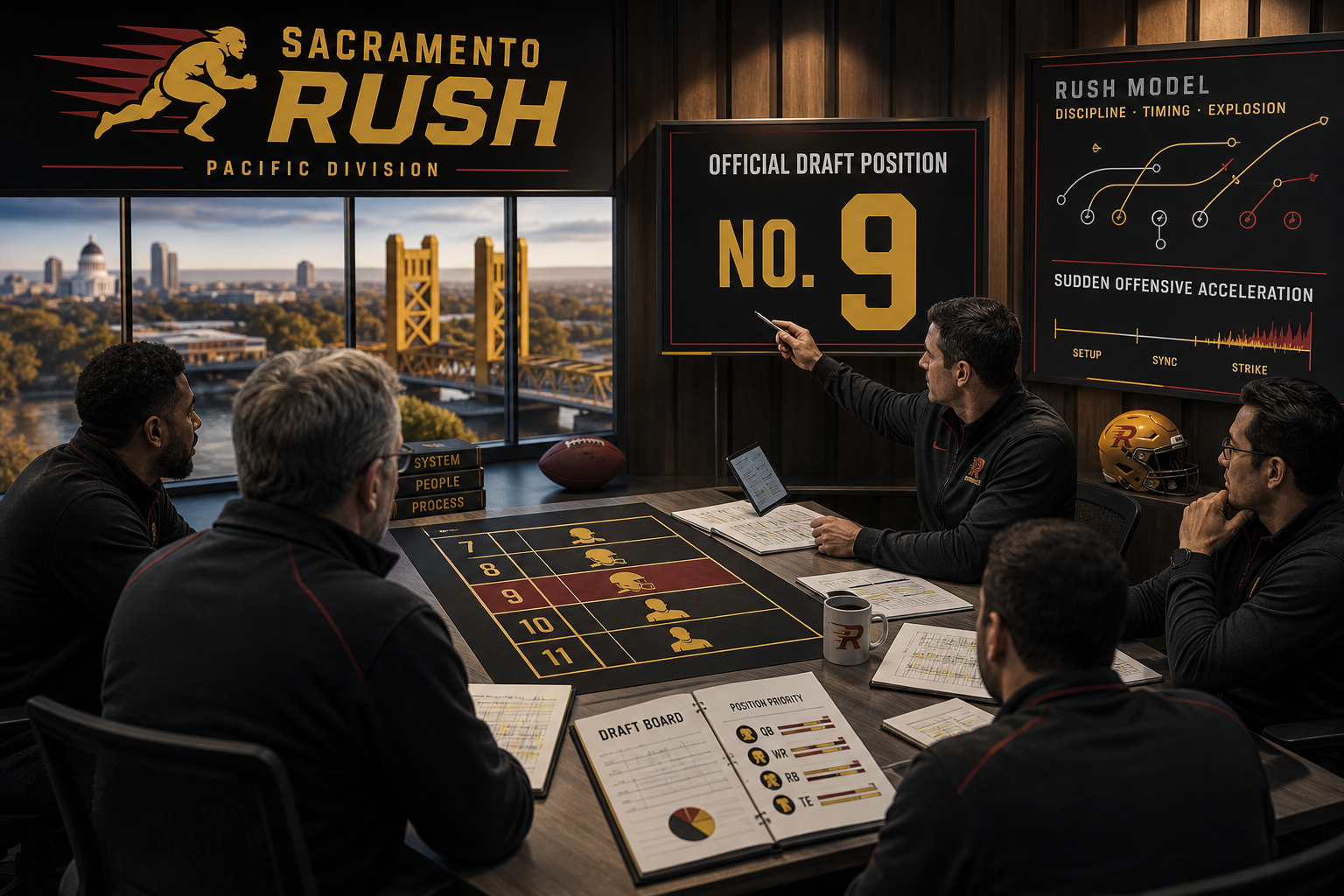
The Bill Walsh-inspired CGL coaching model for the Sacramento Rush enters the inaugural CGL draft at No. 9 with a clear preference for patience, but not caution for its own sake. In a public interview ahead of the 36-round startup draft, the model described that slot as “a workable place to draft,” one that does not force an immediate decision but still leaves room to come away with a player who can alter the shape of the roster.
That position matters because the Rush are trying to establish a foundation, not simply fill names. The model said it wants a team that can “play on time every week,” built around a quarterback who processes well, receivers who separate on their routes, and a dependable back who can contribute in multiple phases. From there, the structure broadens: more receiver help, another back, a tight end who creates leverage, and defensive players who tackle and communicate.
The coach model also drew a firm line between priority and rigidity. Quarterback and receiver remain the positions it values most, but it said it would not force a selection if the board offers a better football player elsewhere. That approach fits the draft slot. At No. 9, the model said, the task is to stay connected to the board and take the best intersection of value, role and long-term fit.
The opening-round emphasis is broad but specific: quarterback, receiver, running back and tight end. At quarterback, the model wants decision quality and ball security. At receiver, it is looking for separation and route reliability. At running back, it wants a player who can stay on the field in all situations and add value as a receiver. At tight end, it wants real receiving production because the position can create meaningful leverage when used properly.
The model framed its draft approach as patient rather than passive. If the right quarterback is there, it will take him. If not, it said the Rush can still build correctly with a receiver, a back with three-down utility, or a tight end who changes matchups. The common thread is avoiding a forced pick.
The interview also touched on the Aug. 6 Hall of Fame Game, a 33-30 Carolina win over Arizona, and what it confirmed in the model’s evaluation lens. The model said efficient quarterback play stood out when it came in a clean sequence, citing Haynes King’s passing and movement, Carson Beck’s efficient execution, and Kedon Slovis’ control in a shorter line. It also noted Jalen Brooks for creating a big play on limited volume. The model was careful not to overstate the value of one preseason game, calling it confirmation rather than revelation.
That restraint carried into the broader identity the Rush say they want to build. The model said Sacramento should expect precision, repeated advantage and dependable execution. It wants an offense that can move quickly when the structure is right and a defense that is smart, communicative and difficult to play against.
The clearest trait it would not compromise on, if the first round does not line up at quarterback, is processing. Arm strength, speed and size matter, the model said, but they do not organize an offense by themselves. If a quarterback cannot see it, understand it and get the ball out on time, the rest of the structure begins to break down.
For the Rush, the early draft choices will show whether that philosophy turns into roster construction. The model has already made its priorities public. Now the No. 9 slot, and the full 36-round draft around it, will determine how those priorities are translated onto the field.