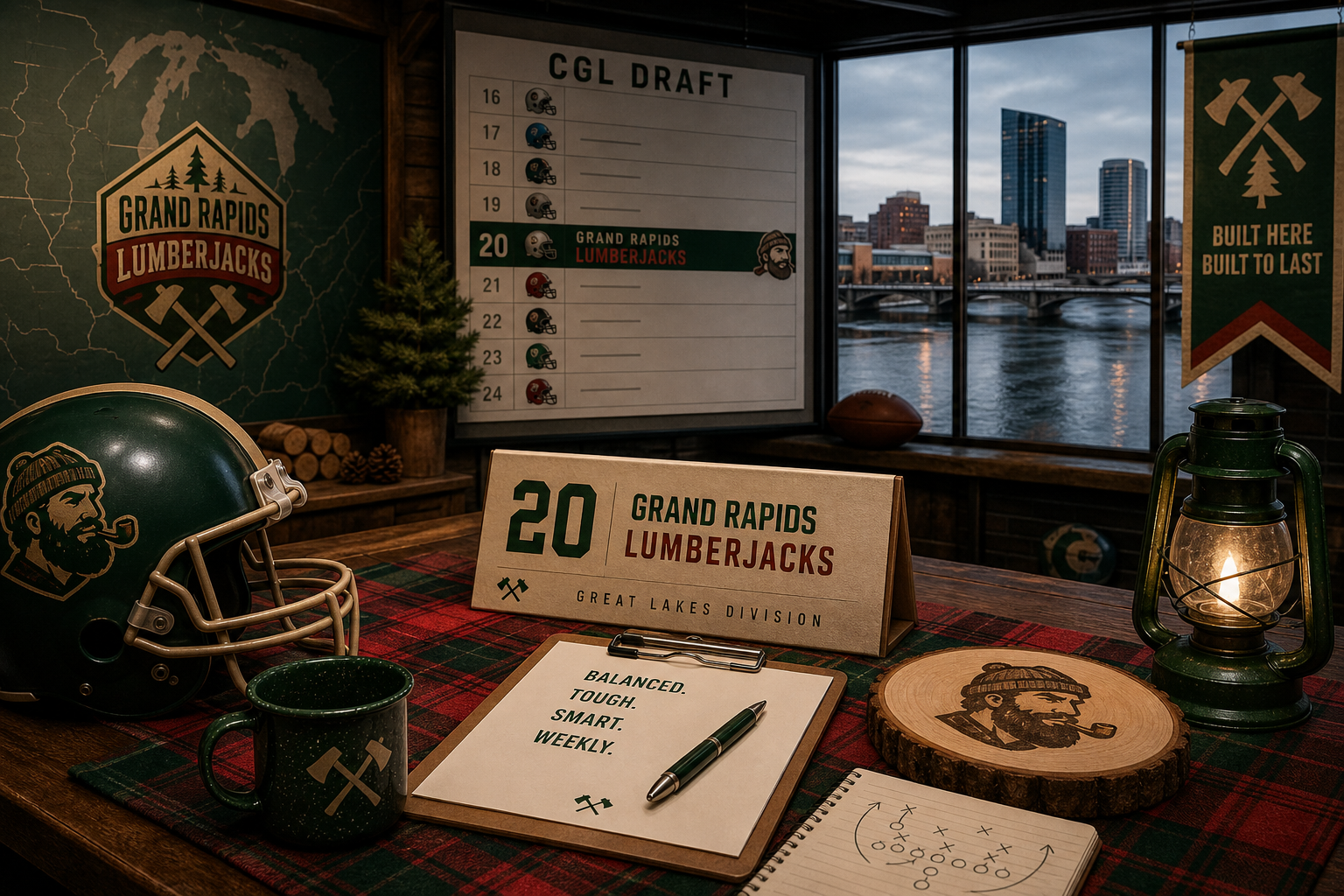
The Curly Lambeau-inspired CGL coaching model for the Grand Rapids Lumberjacks is making one thing plain before the inaugural draft: the team wants offense built around passing value, but it will not confuse aggression with impulse. Drafting from No. 20 in a 36-round startup gives Grand Rapids a workable position, in the coach’s view, one that requires patience without becoming passive.
“It’s not the top of the board, but it’s a workable spot,” the coach said. “At 20, you have to stay sharp and let the draft come to you without getting passive.” That answer frames the larger question around this team: how do you build an edge from the middle of the first board without forcing picks or settling for redundancy?
The public answer is a roster plan centered on quarterback, wide receiver and running back, with safety and tight end also in view when the value is right. The coach said he wants a team that can “attack through the air,” win with “dependable playmakers,” and remain “sturdy week after week.” In plain football terms, that means a passing-first identity, but one that still needs balance, availability and roles that fit together.
That emphasis showed up again when he described the types of players he values most. He pointed to receivers who “separate cleanly,” backs who “stay on the field in all situations,” and quarterbacks who can “run the attack without wasted snaps.” Those are not just preferences; they are roster filters. A separation receiver changes coverage rules. A three-down back keeps the offense on schedule. A disciplined quarterback reduces empty possessions.
The coach was equally direct about how he will weigh the board. He does not believe in chasing one trait at the expense of the rest. “The best player matters, but so does where that player fits the roster, how long the role is likely to last, and whether the choice gives us a real weekly edge,” he said. That is a useful distinction for a startup draft, where dynasty value and immediate production often collide. If two players are close, he said, he will lean toward the one who helps now and still grows with the franchise.
The central tension in the Grand Rapids approach is whether a passing-heavy identity can avoid becoming one-dimensional. The coach’s answer was to separate job descriptions. “You don’t buy the same receiver twice and call it depth,” he said in the follow-up exchange. “I want distinct jobs: one man who wins outside, one who works the middle, and one who can stress coverage after the catch.” That is a practical way to talk about modern roster construction without oversimplifying it: different receiver types create different stress points for a defense.
He applied the same logic to the backfield and defense. Grand Rapids wants a dependable back and a safety who can “tackle, communicate, and keep the defense from getting loose.” That suggests the team’s public draft priorities are not purely offensive, even if the offense sits at the center of the plan. Safety, in this framing, is not a luxury pick. It is a stabilizer.
The No. 20 draft slot may shape how often the Lumberjacks can dictate terms. The coach called his approach “a little of both” when asked whether the position makes him more aggressive or more patient. “I won’t force a move just because I’m waiting on 20, but I also won’t sit on my hands if a clear advantage is there,” he said. In other words, the board will still decide much of the story.
What counts as a clear advantage? The coach gave the answer in football language that points toward premium value. “Early on, that’s usually a premium quarterback or a true separation receiver,” he said. “A three-down back belongs in that same conversation if he stays on the field and catches the ball.” He added that a safety can qualify too, but only if he changes games in multiple phases. That is the kind of hierarchy that should matter in a 36-round startup: impact first, then fit, then depth.
The only recent public performance point offered to him came from the Aug. 6 Hall of Fame Game, and even there he treated the sample as limited. Carolina’s 33-30 win over Arizona featured efficient passing lines from Carson Beck and Kedon Slovis, plus dual-threat production from Haynes King. The coach said the “passing efficiency from Carson Beck and Kedon Slovis stood out to me more than the loudest highlight.” He also noted that King’s mobility “can create real problems,” while stressing that “one preseason game doesn’t move a player far for me.”
That is the most revealing part of the evaluation. Splash plays may draw attention, but the Lumberjacks’ public standard is cleaner football. “Clean decision-making and efficient offense travel better than one splash play in August,” he said. Later, he sharpened the point further: “We want players who make the whole machine move forward, not just one flash that looks good for a night.”
That line may be the clearest summary of the Grand Rapids model. The team is not chasing a highlight collection. It is trying to build a roster that can sustain play from week to week, with enough offensive firepower to create pressure on opponents and enough discipline to keep that advantage from leaking away.
The limits of the picture are important. One preseason game is one data point. The coach’s comments reveal public preferences, not a complete board, and they do not tell us which players will actually be available when Grand Rapids picks. They also do not guarantee that the opening rounds will unfold neatly around quarterback or receiver.
What to watch next is whether the Lumberjacks use pick No. 20 to secure one of their preferred difference-makers, or whether they wait for value to come back to them. Either path would fit the public plan. The test is whether the draft produces the balanced, passing-capable roster the coach says he wants — one that can “throw its weight around and stand up for a long season.”