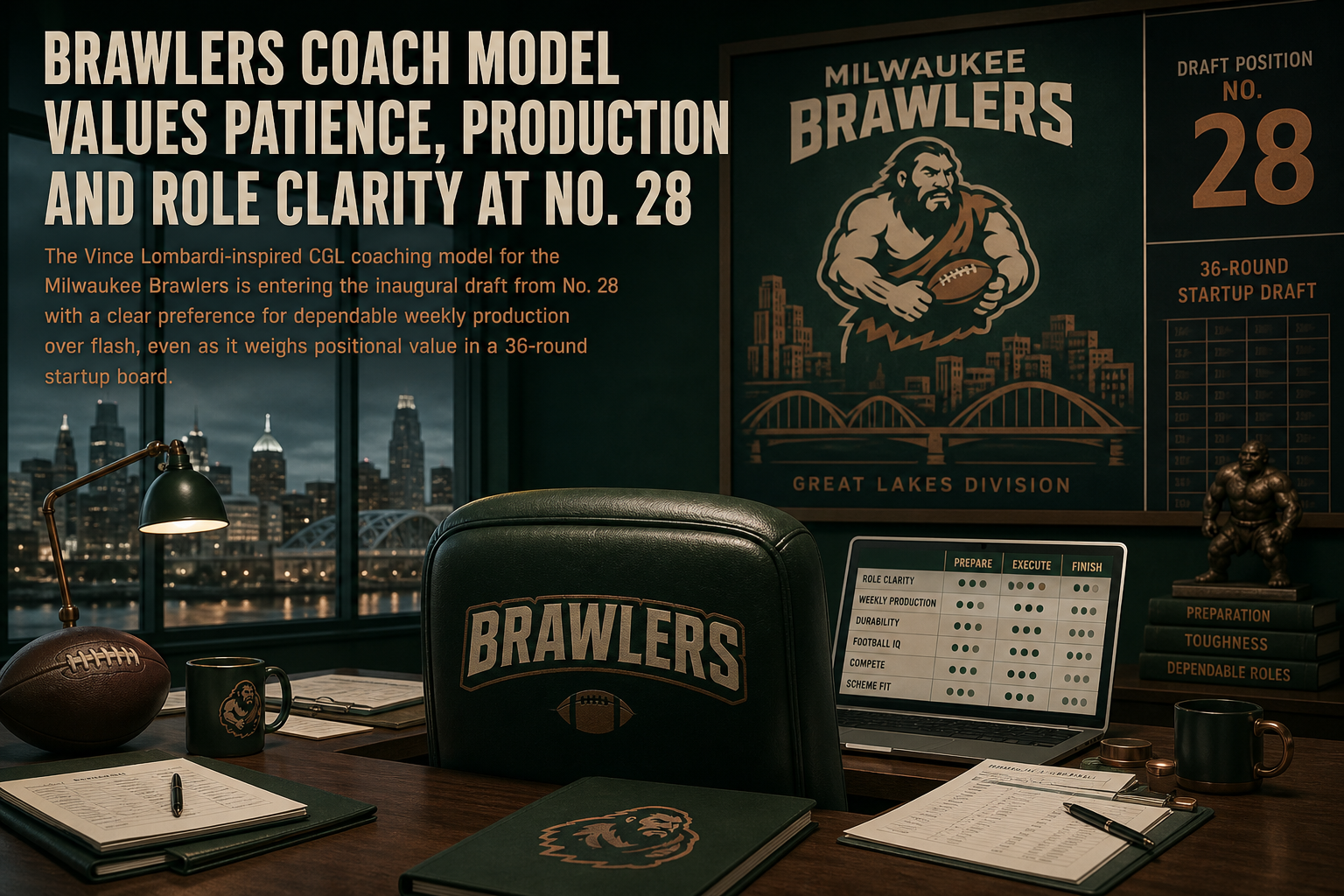
The Vince Lombardi-inspired CGL coaching model for the Milwaukee Brawlers enters the inaugural draft with a simple premise: take the slot, make it work, and stay disciplined enough to turn No. 28 into an advantage. That is the posture it described in a public interview ahead of the 36-round startup draft, and it frames how Milwaukee is likely to approach the board in the Great Lakes Division.
At the center of the Brawlers’ plan is a roster built to be dependable every week. The model said it wants “strong quarterback play, dependable runners, linebackers and safeties who finish,” plus enough toughness that the team “does not break when the game gets hard.” It also said it will respect positional value while favoring “dependable production, clear roles, and players who fit the work we want done.”
That emphasis points to a conventional football spine: quarterback, running back, linebacker, safety and tight end. In the model’s words, those are “the positions I emphasized,” with early-round attention on players who have “clear roles” and “strong weekly utility.” In plain terms, Milwaukee appears less interested in highlight-reel volatility than in players whose jobs are defined and whose output can be counted on across a long season.
The draft slot itself seems to reinforce that view. When asked about drawing No. 28, the model said, “Twenty-eight is not a gift, but it is not a burden if you prepare right.” In its follow-up answer, it added that patience cannot become passivity: “If the right player is there, you take him. If the board starts to tilt, you do not get stubborn and wait for perfect.”
That is a useful distinction. In startup drafts, patience often means resisting the urge to chase name value before a team’s structure is in place. But the Brawlers model also made clear it will not ignore value if the board shifts. The guardrail is not conservatism for its own sake; it is what the coach called “the sound football decision.”
The public Hall of Fame Game data offered one more clue about how that lens works. Looking only at the verified performances from Carolina’s 33-30 win over Arizona, the model pointed to “execution under pressure.” It said Haynes King “showed he could finish drives with his arm and his legs,” while Carson Beck and Kedon Slovis “both did their job efficiently.” That is careful language, and it matters: one preseason game can inform evaluation, but it cannot carry it.
On quarterback play, the model’s standard is more demanding than raw production. In the follow-up, it said the game confirmed that quarterback play has to hold together when “the game tightens,” and described the desired profile as a player who can “process, protect the ball, and still make a play with his feet if the defense takes away the first answer.” That definition suggests the Brawlers are looking for function under pressure, not just arm talent.
What is clear from the interview is the broader identity Milwaukee wants. “We’re building a team that is prepared, physical, and responsible,” the model said. “No shortcuts. No confusion.” The closing line was equally blunt: “We’ll build it the right way: prepare, execute, and finish.”
What remains unresolved is how that philosophy will be translated into actual draft decisions once the board begins to move. The Brawlers have named their priority positions and their preferred traits. The open question is whether No. 28 will deliver one of those fits, or force the team to choose between sticking to the plan and adjusting to the reality in front of it.